
Colombian Coffee: A Deep Dive into History, Terroir, Production and Culture
 Introduction
Coffee is woven into the fabric of Colombian society. From the verdant slopes of the Andes to the Caribbean coastal ranges, millions of smallholder farmers tend coffee trees that have shaped their landscapes, culture and economy for more than two centuries. Colombia is the world’s third‑largest exporter of coffee and the leading exporter of washed Arabica[1][2]. The crop is grown in 23 of the country’s 32 departments and provides livelihoods for more than half a million families[1][3]. This article explores why Colombian coffee is special, combining historical context, geographical diversity, production statistics, socio‑economic considerations and flavour profiles. Charts and graphics throughout the text illustrate long‑term production trends and export dynamics.
History and Cultural Context
Arrival of coffee and the Coffee Cultural Landscape
Coffee arrived in Colombia in the 18th century via Jesuit missionaries and was cultivated primarily in the eastern Andes. By the early 19th century commercial exploitation began; the Viejo Caldas region soon became the largest exporter, and coffee quickly intertwined with national identity[3]. The landscape created by generations of coffee farmers in the departments of Caldas, Quindío and Risaralda—known collectively as the Coffee Cultural Landscape of Colombia (Eje Cafetero)—is recognised by UNESCO as a World Heritage Site. Despite covering only about 13 870 km² (≈1.2 % of Colombian territory), it accounts for roughly 15 % of the country’s coffee land[4]. Today coffee cultivation extends far beyond this triangle to Huila, Tolima, Antioquia, Cauca, Nariño, Santander and the Sierra Nevada[4][10].
Role of the Federación Nacional de Cafeteros (FNC)
The Federación Nacional de Cafeteros de Colombia (FNC) was founded in 1927 to represent coffee growers, stabilise prices and promote the Café de Colombia brand. It is collectively owned by about 540 000 producers, around 95 % of whom are smallholders farming less than five hectares[4][4]. The FNC funds research through Cenicafé, runs extension services, maintains price stabilisation funds and markets Colombian coffee domestically and abroad. It also administers a geospatial platform to meet the European Union’s deforestation‑free regulation (EUDR) and enforces the Café de Colombia geographical indication, which has been protected in the EU since 2007 and in the UK since 2020[8][8]. Coffee and the FNC are so influential that domestic coffee prices are reported daily in national media and coffee accounts for around 15 % of Colombia’s agricultural GDP[3][3].
Growing Regions and Terroir
Diverse geography and microclimates
Colombia straddles the equator and is bisected by three branches of the Andes, creating varied microclimates. Coffee thrives at elevations between 1 200 m and 1 800 m above sea level where daytime temperatures average 17–23 °C[5]. Stable tropical conditions permit two harvests: the main crop typically ripens from September to December and a mitaca (secondary harvest) occurs about six months later[4]. This bimodal cycle ensures near‑year‑round availability.
The northern departments (e.g., Santander and Sierra Nevada) produce coffees with deeper, earthier flavours and lower acidity, often showing nut and chocolate notes[4]. The central regions (Quindío, Caldas, Risaralda, Tolima and Antioquia) yield balanced coffees with fruity, herbal undertones, while the southern highlands of Huila, Cauca and Nariño produce smooth, sweet cups with high acidity and citrus brightness[4]. Volcanic soils and a stable climate allow beans to develop slowly, enhancing complexity. Kai Coffee notes that farms at these elevations are typically small family‑owned enterprises, shade‑grown and hand‑picked[5]. Because of these conditions, Colombian coffee cherries often ripen more uniformly, contributing to consistent quality.
Key producing departments
The FNC’s data show that the main producing departments by volume are Huila, the Eje Cafetero departments of Quindío, Caldas and Risaralda, followed by Antioquia, Tolima, Cauca, Valle del Cauca, Santander and Nariño[10]. Huila alone contributes more than 15 % of national production and is known for its bright acidity and complex fruit flavours. Tolima and Cauca produce coffees with cocoa, nut and herbal notes, while Nariño’s high elevations near the equator yield intensely sweet, citrus‑driven profiles[6].
Production Statistics and Trends
Long‑term production
After a steep decline in the early 2010s due to coffee‑leaf rust and ageing trees, Colombian output recovered through large‑scale replanting with rust‑resistant varieties. Figure 1 charts approximate production (million 60‑kg bags) using data from the United States Department of Agriculture’s (USDA) Coffee Annual and Semi‑annual reports[9][9][9]. Production peaked at over 14 million bags in the mid‑2010s, dipped to 10.7 million bags in the 2022/23 marketing year due to excessive rainfall and La Niña conditions[9][9], and rebounded to 12.9 million bags in 2024/25[9]. The USDA’s official 2025/26 forecast calls for 12.5 million bags, while its field office (“new post”) projects 13.8 million bags, reflecting uncertainty over prolonged rains and tree exhaustion[9][9].

Figure 1. Approximate Colombian coffee production (million 60‑kg bags) by marketing year (2011–2026). Data compiled from USDA Coffee Annual and Semi‑annual reports[9][9][9].
Recent production and exports
The 2024/25 marketing year marked the highest output in three decades, with the FNC estimating 14.8 million bags thanks to aggressive pruning and favourable weather[9]. However, heavy rains delayed flowering and fruit ripening, and FNC CEO Germán Bahamón noted that April 2026 output was only 697 000 bags, 1 % below the previous year[9]. By May 2025–April 2026, cumulative production fell to 12.407 million bags, a 17 % decline from the preceding 12‑month period[9]. Exports over the same period dropped 7 % to 11.9 million bags[9]. In the USDA’s Coffee Semi‑annual, exports for 2025/26 are forecast at 12.5 million bags, with imports of 1 million to satisfy domestic demand[9].
Domestic consumption remains relatively stable at around 2.2 million bags, while the United States consumes more than 40 % of Colombia’s exports[11]. China, previously a minor buyer, is becoming a significant importer according to the 2024 Semi‑annual report[9]. Colombia imports some lower‑priced coffee from Brazil, Peru and Ecuador to meet demand for blended and soluble products[11].
Export vs domestic consumption
Colombian coffee is overwhelmingly export‑oriented—about 93 % of production is shipped abroad[9]. Figure 2 illustrates how exports dwarf domestic consumption; only a small fraction of the crop is retained for local drinking and value‑added products.

Figure 2. Approximate share of Colombian coffee exported versus consumed domestically. About 93 % of production is exported[9].
Farming Practices and Processing
Smallholder dominated agriculture
Colombia’s coffee sector is built on small farms. The FNC reports about 552 000 producers with an average farm size of 1.5 hectares[10]. Around 96 % of producers operate farms under five hectares, and only 1 % exceed 10 hectares[10]. Many farms are family‑run; women head roughly 30 % of them[10]. Coffee is typically grown under shade trees, which conserve soil moisture and biodiversity, and cherries are hand‑picked to ensure only ripe fruit is harvested[5].
Varieties and research
Colombia exclusively grows Arabica coffee[7]. Traditional varieties include Typica, Bourbon and Caturra, but the country has invested heavily in developing disease‑resistant cultivars. In the 1980s the FNC released Castillo (originally “Colombia” variety), which is resistant to coffee‑leaf rust and suits high‑altitude conditions. The research institute Cenicafé continues to innovate; by 2024 87 % of Colombia’s coffee area was planted with rust‑resistant varieties and a new cultivar, Castillo 2.0, was released[1][9]. The semi‑annual report notes that tree density averages 5 340 trees per hectare and productivity exceeds 14 bags per hectare[11].
Harvesting and processing methods
The vast majority of Colombian coffee is fully washed, producing a clean cup that highlights terroir[4]. The pulp is removed soon after picking, beans are fermented to break down mucilage, and then washed and dried. In some regions farmers use water‑saving pulpers and parabolic drying beds to improve efficiency[4]. Although Colombia is famous for washed coffee, some producers are experimenting with natural and honey processing to cater to specialty markets[4]. The semi‑washed method described by Gillies Coffee leaves a portion of mucilage on the beans and can impart light floral sweetness[6].
Flavour Profiles and What Makes Colombian Coffee Special
General characteristics
Colombian coffee is prized for its balanced flavour, combining bright acidity, medium body, nutty sweetness and chocolate undertones[7]. The slow ripening at high elevations produces high oil content and aromatic compounds, leading to complex flavours and a pronounced aroma[6]. Because beans are mostly washed, cups have a clean finish with well‑defined notes; natural and honey processes yield fruitier or sweeter profiles.
Regional nuances
- Cauca – Coffees grown by indigenous communities in the volcanic soils of Cauca display nutty almond and honeycomb notes[6].
- Antioquia – Beans from this mountainous department are smooth with raw sugar and caramel flavours[6].
- Nariño – High‑altitude farms near the equator produce coffees with intense acidity, herbal tones and juicy citrus notes[6].
- Huila – The country’s largest producing department offers a spectrum from smoky and woody to fruity flavours like lime and papaya[6].
- Sierra Nevada – Coastal mountains yield coffees with a full body, lower acidity and notes of hazelnut and dark chocolate[6].
What makes Colombian coffee special?
Several factors contribute to the unique reputation of Colombian coffee:
- Geographical diversity and climate. The Andes create numerous microclimates, enabling year‑round harvests and fostering a wide range of flavours[4][4].
- High altitude and volcanic soils. Farms situated between 1 200–1 800 m enjoy cool temperatures, high rainfall and rich soils that encourage slow maturation and complex flavours[5][6].
- Strict quality control and hand‑picking. The FNC’s quality programmes and farmers’ practice of hand‑selecting ripe cherries result in consistent, defect‑free beans[7][5].
- Washed processing. Colombia’s near‑universal use of the washed method removes mucilage and highlights the intrinsic flavours of each variety[4][7].
- Commitment to research and innovation. Investment in rust‑resistant varieties and agronomic practices has kept yields high despite disease pressures; improved cultivars such as Castillo and Castillo 2.0 are examples[1].
- Strong collective marketing. The Café de Colombia brand, protected as a geographical indication in several jurisdictions, assures buyers of origin and quality[8]. The FNC’s marketing campaigns featuring Juan Valdez have become iconic worldwide.
Market, Trade and Policy
Major export markets and trade dynamics
The United States remains Colombia’s largest buyer, taking more than 40 % of exports, followed by the European Union, Canada and Japan[11]. The FNC and private exporters handle shipments; Fedecafe accounts for roughly 18 % of exports while private traders move the rest[11]. In recent years, China’s coffee consumption has grown rapidly, turning the country into an emerging market for Colombian beans[9].
Domestic consumption and imports
Per‑capita coffee consumption in Colombia is relatively low compared with production. Domestic demand is about 2.2 million bags, and many consumers prefer soluble or blended coffees[11][11]. To meet demand for lower‑cost blends, Colombia imports coffee—principally from Brazil, Peru and Ecuador. Imports in the 2025/26 marketing year are forecast at 1 million bags[9]. Nevertheless, small but growing segments of the domestic market appreciate specialty coffees and the Café de Colombia quality seal is licensed to more than 850 domestic brands[11].
Price stabilisation and policy initiatives
The FNC administers a price stabilisation fund, and in April 2024 the Colombian government created a Coffee Income Compensation Mechanism(MECIC‑2024) to provide payments when farmgate prices fall below a reference level[11]. Although the mechanism has not yet been activated due to high prices, it exemplifies efforts to protect farmer incomes in a volatile market.
Environmental and regulatory challenges
Climate variability remains a major challenge. Excess rain from La Niña events has led to declining yields in recent years[9][9], while rising temperatures and irregular rainfall threaten long‑term suitability of current growing areas. The European Union’s deforestation‑free regulation (EUDR), with compliance deadlines starting in 2025, requires traceability down to the farm level; the FNC is deploying a geospatial platform to help growers meet these requirements[11].
Socio‑economic Impact
Coffee provides livelihoods for over 550 000 families[1][3]. More than 95 % are smallholders, and coffee contributes around 16 % of Colombia’s annual agricultural GDP[4]. The sector supports extensive rural employment: labourers hand‑pick cherries, prune trees, maintain shade canopies and perform wet‑mill processing. The FNC has also promoted programmes to encourage generational renewal, addressing concerns about an ageing farmer population[10]. Migrant workers from Venezuela have recently filled labour gaps during harvest seasons[10].
The cultural importance of coffee cannot be overstated. Coffee is present in national myths (e.g., the fictional coffee farmer Juan Valdez), in daily life (tinto—strong black coffee—is consumed at all hours), and in Colombia’s global image. The FNC’s marketing campaigns have successfully associated the country with high‑quality Arabica. The Café de Colombia geographical indication protects more than 550 000 smallholder families in international markets[2].
Challenges and Future Outlook
Climate change and productivity
Colombia’s success in coffee production depends on adapting to climate change. La Niña‑induced rainfall over the past decade has reduced yields and increased disease pressure[9][9]. Though improved cultivars and better agronomy have boosted resilience, average productivity per hectare remains below its potential. The FNC’s replanting programme continues to renovate ageing trees with rust‑resistant varieties, and research into drought‑tolerant cultivars is ongoing. Diversification into cacao or other crops is being considered in some high‑risk areas[11].
Market volatility and regulatory risks
Coffee prices are notoriously volatile. Farmgate prices reached 3.12 million Colombian pesos per 125‑kg bag (≈US $756) in February 2025[9], but subsequent declines have squeezed margins. New sustainability regulations such as the EUDR impose additional compliance costs. Still, high demand for specialty coffees and Colombia’s strong branding should support long‑term growth. Expanding into emerging markets like China and enhancing domestic consumption could diversify revenue streams.
Innovation and sustainability
Cenicafé’s release of Castillo 2.0 in 2024 marks a new phase of breeding aimed at higher yields, improved cup quality and greater resilience to climate stress[1][9]. Farmers are experimenting with natural and honey processes to create distinctive flavour profiles, and some cooperatives are investing in shade‑tree diversity, water‑efficient pulping and renewable energy. The FNC’s continued investment in research, extension and market access—along with government policy—will determine how Colombia navigates the challenges ahead.
Conclusion
Colombian coffee occupies a unique place in the global coffee landscape. Its history is intertwined with national identity, its geography spans multiple mountain ranges and microclimates, and its farmers—mostly smallholders—have built a culture of quality through hand‑picking and washed processing. Robust institutions like the FNC underpin research, marketing and price stabilisation. Statistics reveal a sector that has recovered from disease and weather shocks to produce nearly 13 million 60‑kg bags annually, exporting more than 90 % of this volume[9][9].
What makes Colombian coffee special is the synergy of altitude, climate, soil, varieties, people and careful processing. Whether you enjoy a bright and citrusy cup from Nariño or a chocolatey brew from Antioquia, every sip tells the story of a country whose economy, culture and environment are shaped by coffee. Sustainable farming practices and continued innovation will be essential for Colombia to maintain its reputation amid climate change and evolving market demands.

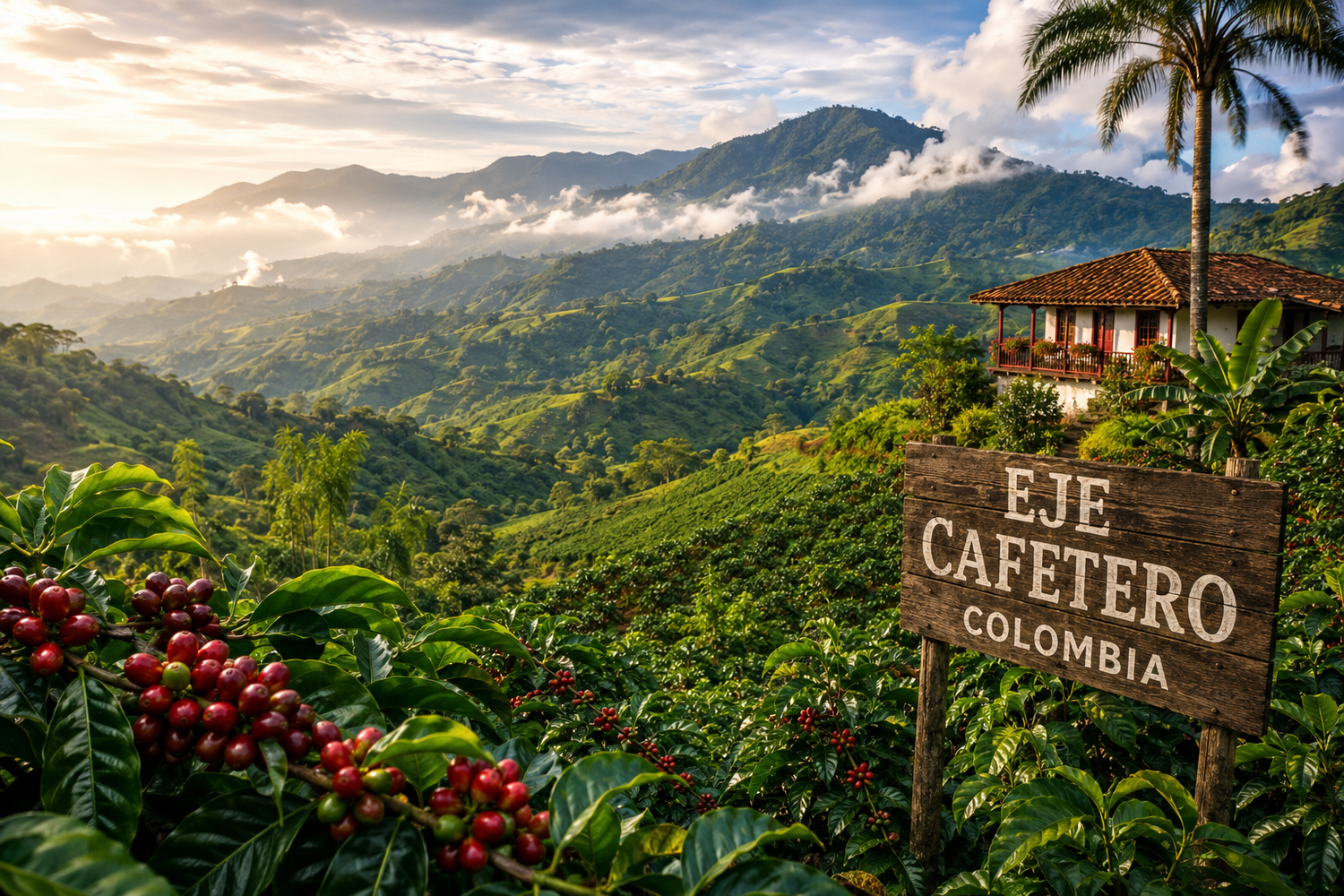
Figure 3. A generative illustration of a coffee plantation in Colombia’s Andes. Lush coffee plants bearing red cherries thrive on terraced hillsides under warm sunlight, symbolising the beauty and vitality of Colombia’s coffee regions.
- [1] World Coffee Research – “Colombia” country page with statistics on production, smallholder families and rust-resistant varieties
- [2] CBI: Entering the French coffee market – notes on Colombian coffee as the world’s largest producer of washed Arabica and the protected “Café de Colombia” brand
- [3] Slow Food Foundation: How coffee shaped Colombia – historical context, socio‑economic contributions and the influence of the FNC
- [4] Sucafina: Origins – Colombia – details on producers, smallholders, regional flavour differences, harvest cycles and processing methods
- [5] Kai Coffee: “Colombian Coffee: A Brief Overview” – description of high‑altitude growing conditions, harvest seasons, and farm practices
- [6] Gillies Coffee: “What Makes Colombian Coffee Stand Out?” – explanation of high‑altitude varietals, semi‑washed processing and regional flavor profiles
- [7] Cartograph Coffee: “Colombian Coffee vs. Arabica Coffee” – comparison of Colombian coffee flavours, hand‑picking and washed processing
- [8] Federación Nacional de Cafeteros: “Protection and enforcement of Café de Colombia around the world” – geographical indication recognition and FNC responsibilities
- [9] Daily Coffee News (Dec. 15, 2025): “Colombia Coffee Report: Production and Prices Remain Historically High” – USDA/FAS semi‑annual report summarizing production (13.8 M bags), exports, export share, technified crops and rust‑resistant varieties
- [10] Daily Coffee News (May 24, 2024): “Colombia Coffee Report: Production Increases as EUDR Approaches” – information on FNC statistics, smallholder percentages, domestic consumption and imports, and EUDR compliance
- [11] Daily Coffee News (May 29, 2025): “Colombia Coffee Report: Production Decline Predicted Amid Weather and Regulatory Volatility” – forecasts for 2025/26, export destinations, FNC share of exports, domestic consumption and imports
- [12] Global Coffee Report (Dec. 11, 2024): “Colombian coffee yield up 20 per cent in 2024” – notes on the 13.6 M bag crop, crop value and export shares
Colombian Coffee: A Deep Dive into History, Terroir, Production and Culture
Read more…
Why Do People Still Go to Starbucks When Better, Cheaper Coffee Exists?
Read more...
What Are the Good and Bad Health Effects of Coffee?
Read more...
How Much Coffee is Safe to Drink Daily?
Read more...Tips & Guides
View all-

Best Coffee Brewing Methods: How to Choose the ...
Compare popular coffee brewing methods, including pour-over, drip, French press, espresso, cold brew, AeroPress, and moka pot, and learn which roast works best for each.
Best Coffee Brewing Methods: How to Choose the ...
Compare popular coffee brewing methods, including pour-over, drip, French press, espresso, cold brew, AeroPress, and moka pot, and learn which roast works best for each.
-

Light Roast vs. Dark Roast: What’s the Difference?
Compare light roast vs. dark roast coffee, including flavor, body, acidity, caffeine, brewing methods, and how to choose the best roast for your taste.
Light Roast vs. Dark Roast: What’s the Difference?
Compare light roast vs. dark roast coffee, including flavor, body, acidity, caffeine, brewing methods, and how to choose the best roast for your taste.
-

How to Choose the Right Coffee Roast
Learn how to choose the right coffee roast for your taste, brewing method, and daily coffee routine—whether you prefer light, medium, or dark roast coffee.
How to Choose the Right Coffee Roast
Learn how to choose the right coffee roast for your taste, brewing method, and daily coffee routine—whether you prefer light, medium, or dark roast coffee.
-

Iced Coffee – Crisp, Customizable, and Perfect ...
Iced coffee should be bold, not boring! Learn how to brew it strong, chill it right, and customize it to your taste. ☕❄️
Iced Coffee – Crisp, Customizable, and Perfect ...
Iced coffee should be bold, not boring! Learn how to brew it strong, chill it right, and customize it to your taste. ☕❄️


